Home / Articles / Number Sequence Puzzles With Answers
Number Sequence Puzzles With Answers
A number sequence puzzle gives you the start of a list and asks what comes next. There is no single trick that solves all of them, but there is a reliable order to try things in, and the 12 puzzles below are built to teach it. They are grouped into easy, medium, and hard sets of four. Each puzzle states the rule, gives the next term, and explains the reasoning in full, because the explanation is where the learning happens. Try each one before reading its answer.
Contents
How to approach a sequence you have never seen
Start with differences. Subtract each term from the one after it. If the differences are all the same, you have found the rule. If the differences themselves rise or fall steadily, look at how they change.
Then try ratios. If the numbers grow fast, divide each term by the one before it. A steady ratio means multiply. Growth that is faster than any steady ratio often points to squares, cubes, or a rule that multiplies and then adds.
Check for interleaving. If the sequence jumps up and down, split it into two: the terms in odd positions and the terms in even positions. Each half may follow a simple rule of its own.
Run through familiar families. Squares (1, 4, 9, 16...), cubes (1, 8, 27, 64...), primes (2, 3, 5, 7, 11...), and each-term-is-the-sum-of-the-two-before are worth testing on any stubborn sequence.
Verify before you answer. Whatever rule you settle on must produce every given term, not just the last one. Test it from the start of the sequence. A rule that fails once is wrong.
Easy sequences
Puzzle 1: Steady addition
Sequence: 4, 7, 10, 13, 16, ?
Answer: 19. Every term is 3 more than the one before: 4 + 3 = 7, 7 + 3 = 10, and so on. The next term is 16 + 3 = 19. Steady differences are the first thing to check on any sequence, because they are the most common rule of all.
Puzzle 2: Steady subtraction
Sequence: 50, 45, 40, 35, ?
Answer: 30. Each term drops by 5. Sequences can run downwards as well as upwards, and the method is identical: check the differences first. 35 minus 5 gives 30.
Puzzle 3: Doubling
Sequence: 2, 4, 8, 16, 32, ?
Answer: 64. Each term is double the one before. The differences (2, 4, 8, 16) are not steady, which is your signal to try ratios instead: 4 divided by 2 is 2, 8 divided by 4 is 2, and the ratio stays at 2 all the way through. 32 times 2 is 64.
Puzzle 4: Growing differences
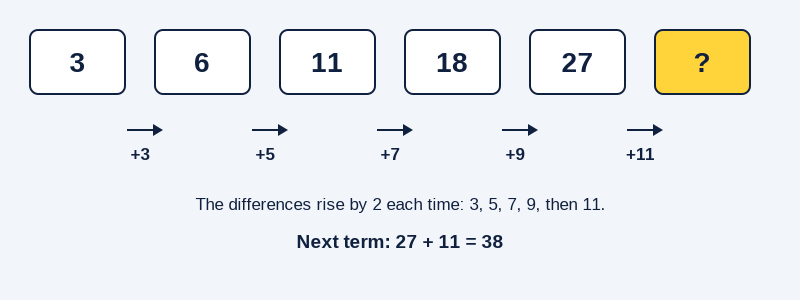
Sequence: 3, 6, 11, 18, 27, ?
Answer: 38. The differences are 3, 5, 7, 9. They are not steady, but they rise by 2 each time. So the next difference is 11, and the next term is 27 + 11 = 38. When differences are not steady, ask whether the differences follow a pattern of their own. Here they do: they are the odd numbers in order.
Medium sequences
Puzzle 5: Multiply, then add
Sequence: 2, 5, 11, 23, 47, ?
Answer: 95. Each term is the previous term multiplied by 2, then plus 1. Check it: 2 x 2 + 1 = 5. 5 x 2 + 1 = 11. 11 x 2 + 1 = 23. 23 x 2 + 1 = 47. So the next term is 47 x 2 + 1 = 95. The differences here (3, 6, 12, 24) double each time, which is the fingerprint of a multiply-then-add rule.
Puzzle 6: Two sequences interleaved
Sequence: 1, 10, 3, 9, 5, 8, 7, 7, ?
Answer: 9. The sequence jumps up and down, so split it. The terms in odd positions are 1, 3, 5, 7, rising by 2. The terms in even positions are 10, 9, 8, 7, falling by 1. The missing term sits in an odd position, so it continues 1, 3, 5, 7, and the next odd-position term is 9.
Puzzle 7: Squares plus one
Sequence: 2, 5, 10, 17, 26, ?
Answer: 37. Each term is a square number plus 1: 1 + 1 = 2, 4 + 1 = 5, 9 + 1 = 10, 16 + 1 = 17, 25 + 1 = 26. The squares are 1, 4, 9, 16, 25, so the next square is 36, and 36 + 1 = 37. Differences of 3, 5, 7, 9 rising by 2 are a classic sign of a square-based rule hiding underneath.
Puzzle 8: Primes in order
Sequence: 2, 3, 5, 7, 11, 13, ?
Answer: 17. These are the prime numbers in order: numbers divisible only by 1 and themselves. After 13, the next prime is 17, because 14, 15, and 16 each divide by smaller numbers. The differences (1, 2, 2, 4, 2) follow no tidy pattern, and that untidiness is itself a clue: when arithmetic fails, test the named families, and primes are one of them.
Hard sequences
Puzzle 9: Alternating operations
Sequence: 3, 6, 9, 18, 21, 42, ?
Answer: 45. Two operations alternate: multiply by 2, then add 3. Check it step by step: 3 x 2 = 6. 6 + 3 = 9. 9 x 2 = 18. 18 + 3 = 21. 21 x 2 = 42. The next operation in the cycle is add 3, so the answer is 42 + 3 = 45. When neither a steady difference nor a steady ratio works, test whether two operations are taking turns.
Puzzle 10: Cubes minus one
Sequence: 0, 7, 26, 63, 124, ?
Answer: 215. Each term is a cube minus 1: 1 - 1 = 0, 8 - 1 = 7, 27 - 1 = 26, 64 - 1 = 63, 125 - 1 = 124. The cubes are 1, 8, 27, 64, 125, so the next cube is 216, and 216 - 1 = 215. Very fast growth, faster than doubling, is the usual sign that squares or cubes are involved.
Puzzle 11: Each term is the sum of the two before it
Sequence: 2, 3, 5, 8, 13, 21, ?
Answer: 34. From the third term on, each term is the sum of the two terms before it: 2 + 3 = 5, 3 + 5 = 8, 5 + 8 = 13, 8 + 13 = 21. So the next term is 13 + 21 = 34. This family is famous enough to have a name, the Fibonacci pattern, but it can start from any two numbers, as it does here. Differences and ratios both fail on it, so if a sequence resists both, test this rule early.
Puzzle 12: Differences with a pattern of their own
Sequence: 5, 6, 9, 16, 29, ?
Answer: 50. The differences are 1, 3, 7, 13. Now look at how the differences change: 3 - 1 = 2, 7 - 3 = 4, 13 - 7 = 6. These second differences rise by 2 each time, so the next second difference is 8, which makes the next first difference 13 + 8 = 21. The next term is 29 + 21 = 50. This is the deepest form of the differences method: keep differencing until a steady pattern appears, then build back up.
Frequently asked questions
What is the fastest way to start on an unknown sequence?
Write the differences between neighbouring terms. That one step solves easy sequences outright and tells you what kind of rule to look for on harder ones: steady differences mean addition, doubling differences suggest multiplying, and irregular differences point to interleaving or a named family.
Can a sequence have more than one correct rule?
In principle, many rules can fit the same short list. Good puzzles are built so that one simple rule fits every term and the alternatives need contrived exceptions. On this site, generated puzzles are checked so that only one option fits the intended rule. If your rule produces every given term with no exceptions, it is almost certainly the intended one.
Do number sequences appear in the IQ test on this site?
Yes. Number sequences are one of the puzzle types in the Numbers area of our test, alongside number grids and short everyday sums. The rules are generated fresh each time, so the exact sequences differ, but the rule families are the ones covered here.
Does practising sequences raise IQ?
Practice makes you faster at sequences, which is a genuine and useful skill. Evidence that this kind of practice raises general intelligence is weak (Simons et al., 2016), so treat improvement as getting better at the task itself.
Source: Simons, D. J., et al. (2016). Do "Brain-Training" Programs Work? Psychological Science in the Public Interest, 17(3), 103-186. https://doi.org/10.1177/1529100616661983
Sources
Encyclopaedia Britannica, Fibonacci sequence. From the third term on, each term of the Fibonacci sequence is the sum of the two terms before it. Accessed 7 November 2026.
Encyclopaedia Britannica, Prime. A prime is a positive integer greater than 1 that is divisible only by itself and 1. Accessed 7 November 2026.
Simons et al. (2016), Do brain-training programs work?, Psychological Science in the Public Interest. Practice improves the trained task, with little evidence of benefit to general ability. Accessed 7 November 2026.
Keep practising
For number planning under a rule, try Path Finder, where you cross a number grid step by step. For a daily mix that includes number puzzles, play Daily Pattern. Or take the free IQ test and meet these rule families under test conditions, with every answer explained afterwards.