Home / Articles / Free Logic Puzzles With Answers
Free Logic Puzzles With Answers
Logic puzzles differ from most puzzles in one satisfying way: the clues are enough. You never need a lucky guess, because each answer is forced by the clues if you work through them in the right order. Below are six original puzzles, each of a different type, each with its difficulty marked and its solution explained step by step. Every puzzle here has exactly one solution, and the explanations show why.
Contents
A short method that works on almost every logic puzzle
Write down what you know. Do not hold clues in your head. Draw the slots (positions, people, objects) and mark what goes where as you learn it.
Eliminate. Most clues tell you what is not true: who did not finish first, which pet is not Maya's. Crossings-out are progress. In a grid puzzle, every "no" narrows every row and column it touches.
Look for the clue that fixes a position. One clue usually pins something down exactly: a last place, an immediate neighbour, a direct swap. Start there, then let the consequences flow into the other clues.
Work the consequences before hunting for new clues. Each fact you place changes what the remaining clues can mean. Chain these deductions until nothing is left open, then check your finished answer against every clue, one by one.
Puzzle 1: The finishing order
Type: Ordering. Difficulty: Medium.
Five runners, Amina, Ben, Cara, Dev, and Elsa, finished a race in positions 1 to 5, with no ties. Work out the full finishing order from these clues:
- Dev finished last.
- Ben finished immediately ahead of Cara (one position ahead, with nobody between them).
- Amina finished ahead of Ben.
- Elsa finished immediately behind Amina.
Solution: 1st Amina, 2nd Elsa, 3rd Ben, 4th Cara, 5th Dev.
How it is forced:
Clue 1 fixes Dev in position 5.
Clue 2 means Ben and Cara form a pair in positions (1,2), (2,3), or (3,4).
If the pair were (1,2), clue 3 would fail, because nobody can finish ahead of position 1. So the pair is (2,3) or (3,4).
Clue 4 means Amina and Elsa form a pair in consecutive positions, Amina first.
Try the Ben-Cara pair at (2,3). The Amina-Elsa pair would need two consecutive free positions. The free positions are 1 and 4, which are not consecutive, and position 2 is taken by Ben. So this placement fails.
So Ben is 3rd and Cara is 4th. Positions 1 and 2 remain for Amina and Elsa, and clue 4 puts Amina immediately ahead of Elsa: Amina 1st, Elsa 2nd. Clue 3 holds, since Amina (1st) is ahead of Ben (3rd). Every clue checks out, and the working shows no other order survives.
Puzzle 2: Who has which pet?
Type: Elimination grid. Difficulty: Easy.
Maya, Noah, and Priya each own exactly one pet. The pets are a cat, a dog, and a parrot, in some order. Work out who owns what from these clues:
- Maya does not own the cat.
- Maya does not own the dog.
- Noah does not own the dog.
Solution: Maya owns the parrot, Noah owns the cat, Priya owns the dog.
Picture a grid with the three people as rows and the three pets as columns. Mark a cross for "no" and a tick for "yes":
Clue 1 puts a cross for Maya and the cat. Clue 2 puts a cross for Maya and the dog. Maya's row now has crosses in two of three columns, so the third is forced: Maya owns the parrot. Tick it, and cross out the parrot for Noah and Priya, since each pet has one owner.
Clue 3 puts a cross for Noah and the dog. Noah's row also has a cross for the parrot, so Noah's remaining column is forced: Noah owns the cat.
Only the dog is left, and only Priya is left: Priya owns the dog. Check against all three clues: Maya (parrot) owns neither cat nor dog, and Noah (cat) does not own the dog. All satisfied, and the grid forced every step, so the solution is unique.
Puzzle 3: The blue object
Type: Must be true. Difficulty: Easy.
You are told three things:
- All Zorps are blue.
- No blue things are square.
- This object is a Zorp.
Which of these statements must be true? A) The object is round. B) The object is blue. C) The object is not square.
Solution: B and C must be true. A does not have to be true.
Step by step: statement 1 says every Zorp is blue, and statement 3 says the object is a Zorp, so the object is blue. That makes B certain. Statement 2 says no blue thing is square. The object is blue, so it cannot be square, which makes C certain too. Nothing in the clues says anything about roundness: Zorps might all be triangular. A could be true, but it is not forced, and "must be true" questions only credit what is forced. That gap, between possibly true and necessarily true, is the whole skill in this puzzle type.
Puzzle 4: Crack the letter code
Type: Code. Difficulty: Easy.
In a code, the word CAT is written as FDW, and the word DOG is written as GRJ. Using the same code, what word is hidden in KHOOR?
Solution: HELLO.
Work out the rule from the examples first. C becomes F, A becomes D, T becomes W. Each letter has moved three places forward in the alphabet: C to F, A to D, T to W. Check the rule on the second example before using it: D to G is three forward, O to R is three forward, G to J is three forward. The rule holds on all six letters, so it is the code, not a coincidence. To decode, move each letter three places back: K back three is H, H back three is E, O back three is L, the second O is also L, and R back three is O. KHOOR decodes to HELLO. Note the method: one example suggests a rule, the second example confirms it, and only then do you apply it.
Puzzle 5: The balanced scales
Type: Balance and weights. Difficulty: Medium.
Every scale shown is perfectly balanced, and all examples of the same shape weigh the same.
Scale 1: two cubes on the left balance one sphere and one cube on the right.
Scale 2: one sphere and one cube together balance six marbles.
Question: How many marbles balance one sphere and two cubes?
Solution: 9 marbles.
Step by step:
Start with Scale 1. A cube sits on both sides. Removing the same weight from both sides keeps a scale balanced, so take one cube off each side. What remains says one cube balances one sphere. A cube and a sphere weigh the same.
Now use Scale 2. It holds one sphere and one cube, and they weigh the same, so that side is really two cubes' worth of weight. Two cubes balance six marbles, so one cube balances three marbles. The sphere, weighing the same as a cube, also balances three marbles.
Answer the question: one sphere (3 marbles) plus two cubes (3 + 3 marbles) equals 9 marbles.
This swap-and-replace method is the whole of our Balance Scale game, and the same swap-and-replace idea also shows up in algebra.
Puzzle 6: The refund chain
Type: If-then chain. Difficulty: Medium.
A sports club works by three strict rules:
- If it rains on match day, the match is postponed.
- If the match is postponed, all ticket holders get a refund.
- If a refund is issued, an email is sent to the ticket holder.
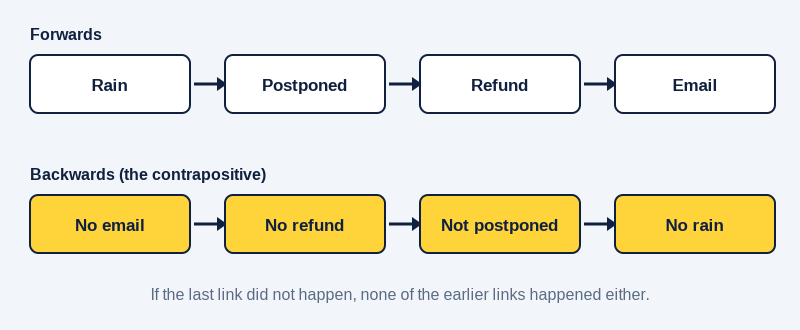
Question A: It rained on match day. What must have happened? Question B: A ticket holder received no email. What must be true?
Solution to A: The match was postponed, a refund was issued, and an email was sent. Each rule fires the next: rain triggers postponement (rule 1), postponement triggers a refund (rule 2), and a refund triggers an email (rule 3).
Solution to B: Work the chain backwards. No email was sent, so by rule 3 no refund can have been issued (a refund would have sent one). No refund means, by rule 2, the match was not postponed. No postponement means, by rule 1, it did not rain on match day. Running a chain backwards like this is called using the contrapositive: if the last link did not happen, none of the earlier links happened either. Note what you cannot conclude in general: if a match is postponed, you cannot conclude it rained, because the rules only say rain is one way to get a postponement. If-then rules travel in one direction, and respecting that direction is what this puzzle type tests.
Frequently asked questions
What if I get stuck halfway through a logic puzzle?
Go back to the clues and check each one against what you have placed so far. The clue that unlocks a stuck puzzle is usually one you used once and forgot to reuse after placing new facts. A clue is not finished with until the final check.
Is guessing ever part of solving a logic puzzle?
In a well-built puzzle, no. Every step can be forced by the clues. If you find yourself choosing between two options that both fit everything you know, you have usually missed a consequence of a clue you already used. Our puzzles on this site are checked so that only one answer fits.
Which type of logic puzzle is best for beginners?
Elimination puzzles like Puzzle 2, because the grid does the bookkeeping for you. Ordering puzzles come next. If-then chains feel easy but hide the one-direction trap shown in Puzzle 6, so read them slowly.
Do logic puzzles appear in the IQ test on this site?
Yes. The Logic area of our test includes orderings, must-be-true statements, if-then reasoning, letter codes, and who-has-what puzzles, generated fresh each time you take it. The types above are the same families, at practice difficulty.
Sources
Stanford Encyclopedia of Philosophy, Classical Logic. Logic studies correct reasoning: an argument is correct when its form is valid or deducible, and the arrow stands for if-then. Accessed 7 November 2026.
Stanford University, Introduction to Logic, Contrapositive. The contrapositive of 'if p then q' is 'if not q then not p', and an implication and its contrapositive are logically equivalent. Accessed 8 November 2026.
Keep going
Practise finding hidden rules in Rule Hunter, crack four-symbol codes in Code Breaker, or swap weights in Balance Scale. Then take the free IQ test to meet all five reasoning areas with every answer explained.