Home / Articles / How to Solve Pattern-Recognition Questions
How to Solve Pattern-Recognition Questions
Pattern questions look hard because everything changes at once. The way to solve them is to slow down and name one change at a time. Ask what changes from one step to the next: how many shapes there are, how big they are, how they are shaded, where they sit, or which way they point. Then check that the change you found stays the same across the whole row or sequence. If it does, use it to predict the next step before you look at the answer options. That order matters. Predicting first stops the wrong options from pulling you towards a rule that only half works.
Contents
- The method, step by step
- Worked example 1: Counting shapes
- Worked example 2: A turning arrow
- Worked example 3: Alternating shading
- Worked example 4: Counting sides
- Where these four rules appear in IQ tests
- Common traps
- Practice questions
- Practice answers
- A note on practice and IQ
- Sources
- Frequently asked questions
The method, step by step
Step 1: List what could change
Look at the first two steps and list every feature that is different. In shape puzzles the usual features are:
- Count: how many shapes or parts there are.
- Size: whether shapes grow, shrink, or stay the same.
- Rotation: which way a shape points.
- Shading: which parts are black, grey, or white.
- Position: where a shape or mark sits.
- Shape itself: for example, how many sides the shape has.
Write the list down if you can. A short list stops you from jumping at the first change you notice and missing a simpler one.
Step 2: Test one change at a time
Pick one feature and follow it through every step. Ignore the rest for now. If the count goes 1, 2, 3, 4, that feature follows a clean rule. If the count goes 2, 3, 2, 4, it does not, so move on to the next feature on your list.
Step 3: Check the rule against the whole sequence
A real rule fits every step, not just the first two. Many wrong answers come from a rule that fits the start of a sequence and breaks later. Before you commit, run your rule across all the steps you can see. If it fails anywhere, it is the wrong rule, however neat it looks.
Step 4: Predict, then eliminate
Use the rule to say what the next step should look like. Only then look at the options. Cross out any option that breaks your rule. If two options survive, your rule is incomplete: there is a second change running alongside the first, so go back to Step 2 and test another feature on the surviving options.
Worked example 1: Counting shapes
The puzzle, in words. A row of five boxes. Box 1 holds one black circle. Box 2 holds two black circles, side by side. Box 3 holds three black circles in a row. Box 4 holds four black circles in a row. What does Box 5 hold?
Options: A) three circles. B) five circles. C) six circles. D) four circles.
Step-by-step reasoning.
What changes? The circles are the same size, colour, and style in every box. Only the count changes.
Follow the count: 1, 2, 3, 4. Each box adds one circle.
Check the rule across the row: it fits all four boxes, with no breaks.
Predict: Box 5 should hold five circles.
Answer: B, five circles.
The common trap. Option C, six circles, tempts people who think the count doubles or jumps. Nothing in the row doubles. The steady rule is add one, and steady rules beat dramatic ones.
Worked example 2: A turning arrow
The puzzle, in words. A row of four arrows. The first points straight up. The second points to the right. The third points straight down. The fourth points to the left. Which way does the fifth arrow point?
Options: A) down. B) left. C) up. D) right.
Step-by-step reasoning.
What changes? The arrow is the same shape and size throughout. Only its direction changes.
Follow the direction: up, right, down, left. Each step turns the arrow a quarter turn (90 degrees) clockwise.
Check the rule: up to right is a quarter turn clockwise. Right to down is another. Down to left is another. The rule holds at every step.
Predict: one more quarter turn clockwise from left brings the arrow back to pointing up.
Answer: C, up.
The common trap. Option B, left, is the answer people give when they simply repeat the last step instead of continuing the turn. A turning sequence never stands still. Always apply the change once more.
Worked example 3: Alternating shading
The puzzle, in words. A row of five squares in a line. The first square is filled black. The second is white, shown as an outline only. The third is black. The fourth is white. What is the fifth square?
Options: A) white. B) half black and half white. C) grey. D) black.
Step-by-step reasoning.
What changes? The shape, size, and position stay the same. Only the shading changes.
Follow the shading: black, white, black, white. It alternates, swapping at every step.
Check the rule: the swap happens between every pair of neighbours, all along the row.
Predict: after white comes black again.
Answer: D, black.
The common trap. Options B and C invent a new shading that the row never uses. Patterns in these puzzles almost always reuse what you have already seen. If an option introduces something brand new, treat it with suspicion.
Worked example 4: Counting sides
The puzzle, in words. A sequence of four shapes in a row: a triangle, then a square, then a five-sided shape (a pentagon), then a six-sided shape (a hexagon). What comes next?
Options: A) a circle. B) a seven-sided shape (a heptagon). C) a square. D) an eight-sided shape (an octagon).
Step-by-step reasoning.
What changes? The shape itself changes each time, so count something about the shape. The clearest countable feature is the number of sides.
Follow the sides: triangle 3, square 4, pentagon 5, hexagon 6. Each shape has one more side than the one before.
Check the rule: 3, 4, 5, 6 rises by one at every step, with no exceptions.
Predict: the next shape has seven sides.
Answer: B, a seven-sided shape (a heptagon).
The common trap. Option D, the octagon, skips a step. Option A, the circle, gives up on counting altogether. When a count is rising steadily, extend it by the same amount, no more and no less.
Where these four rules appear in IQ tests
The four rule types in this article also appear in the pattern sections of standard non-verbal reasoning tests. Counting, rotation, shading and side counting recur because they use simple shapes and need no words. Published tests often use a matrix with one tile missing, while this article uses rows. The method in this article works on both formats.
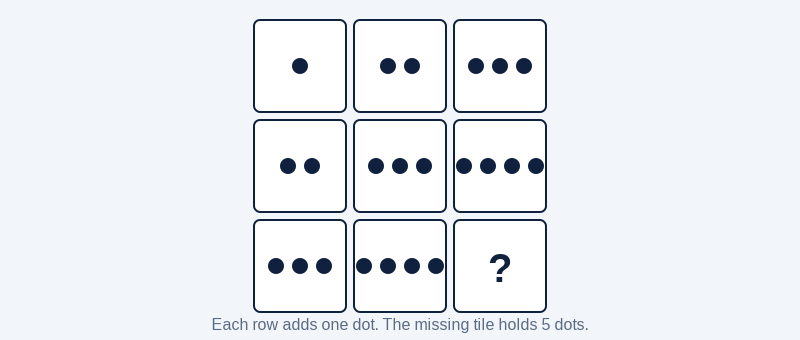
One more, using a rule this article has not used yet. A row of four squares. Each square holds one black triangle. In square 1 the triangle sits in the top right corner. In square 2 it sits in the bottom left corner. Square 3 has it back in the top right, and square 4 back in the bottom left. What comes in square 5?
Options: A) top left. B) top right. C) bottom right. D) bottom left.
What could change? The triangle's corner, its shading or its count. Shading and count never change, so follow the corner: top right, bottom left, top right, bottom left. The triangle jumps to the opposite corner at each step. Check the rule against the whole row: it holds at every step. Predict before you look at the options: square 5 should hold the triangle in the top right corner.
Answer: B, top right.
Common traps
Stopping after two steps. A rule that fits the first two steps may fail at the third. Two points can be joined by many rules. Four or five steps narrow it down. Always check the full sequence.
Watching one feature when two are changing. Some puzzles change two things at once, such as the count rising while the shading alternates. If one rule leaves two options standing, look for the second change instead of guessing between them.
Looking at the options first. Options are written to look plausible. One usually matches a half-right rule. Predict the answer before you read them, then match your prediction against the list.
Inventing a complicated rule. Simple rules explain most pattern questions: add one, turn a quarter turn, swap the shading. If your rule needs three conditions and an exception, a simpler rule is probably hiding underneath it.
Assuming the pattern repeats from the start. Some sequences cycle (large, medium, small, large, medium...), but many simply keep growing or turning. Check whether step four really matches step one before treating the sequence as a loop.
Practice questions
Try these before reading the answers. Say the rule out loud before you choose.
Practice 1. A row of boxes holds black stars. Box 1 has two stars, Box 2 has four, Box 3 has six, and Box 4 has eight. How many stars does Box 5 have?
Practice 2. A circle has a single black dot on its rim. In the first picture the dot is at the top. In the second it is on the right. In the third it is at the bottom. Where is the dot in the fourth picture?
Practice 3. A sequence of squares runs: one large square, one medium square, one small square, one large square, one medium square. What comes next?
Practice answers
Show answer: Practice 1
Ten stars. The count rises by two each time: 2, 4, 6, 8, so the next count is 10.
Show answer: Practice 2
On the left. The dot moves a quarter turn clockwise around the rim at each step: top, right, bottom, so the next position is the left.
Show answer: Practice 3
A small square. The sizes cycle in threes: large, medium, small, then the cycle starts again. After large, medium comes small.
A note on practice and IQ
Getting better at pattern questions is a real skill, and this method will help you read unfamiliar puzzles faster. That is different from raising general intelligence. A large review of brain-training research found good evidence that practice improves performance on the task practised, but little evidence of wider benefits (Simons et al., 2016). Treat these puzzles as practice and enjoyment, and read any test score as an estimate, not a clinical measurement.
Source: Simons, D. J., et al. (2016). Do "Brain-Training" Programs Work? Psychological Science in the Public Interest, 17(3), 103-186. https://doi.org/10.1177/1529100616661983
Frequently asked questions
What should I look for first in a pattern question?
Start with count and position, because they are the easiest to check. Then look at size, rotation, and shading. Work through one feature at a time and follow each one across the whole sequence before moving on.
How long should I spend on one pattern question?
In our test there is no per-question timer, only an overall limit. If a rule has not appeared after a careful pass through each feature, skip the question if the format allows it and return to easier points elsewhere. One hard puzzle is rarely worth three easy ones.
What if two rules both seem to fit?
Apply both rules to every step, not just the first few. One of them usually breaks. If both still fit, use the simpler rule, and check which answer options each rule predicts. Options often settle it.
Can practising pattern questions improve my test score?
Practice helps you recognise rule types faster, so it can lift your score on similar puzzles. Our test generates a fresh set of puzzles each time, but the rule types repeat, so a method like this one transfers. That is a practice effect, not proof of a change in general ability.
Sources
Pearson Assessments, Raven's Progressive Matrices, Second Edition (Raven's 2). A standard non-verbal reasoning test that measures clear-thinking ability while minimizing language and cultural effects; it gives a standard score and a percentile rank. Accessed 7 November 2026.
Simons et al. (2016), Do brain-training programs work?, Psychological Science in the Public Interest. Practice improves performance on the trained task, with little transfer to other tasks. Accessed 7 November 2026.
Try it now
Put the method to work in Daily Pattern, which gives you three explained puzzles a day, or in Rule Hunter, where you work out a hidden rule from examples. When you are ready, take the free IQ test and see how the Patterns area feels with a method behind you. If you want to know what a score from a short online test can and cannot tell you, read Are online IQ tests accurate?