Home / Articles / What does an online IQ test measure?
What does an online IQ test measure?
An online IQ test measures how you performed on a small set of reasoning tasks, usually pattern recognition, number reasoning, logical deduction, spatial reasoning and analogies, on the day you took it. The score is a conversion of that performance into an estimate on the IQ scale. It is not a direct reading of general intelligence, and it does not sample memory, vocabulary, processing speed, general knowledge, creativity or social and emotional ability.
Contents
- The short answer: a sample, not a census
- The five reasoning areas this test samples
- What the result actually represents
- What an online IQ test does not measure
- Why a short quiz cannot assess every cognitive ability
- How professional test batteries differ
- A worked example: reading a result sensibly
- Sources and limitations
- Sources
- Frequently asked questions
- Try the test
The short answer: a sample, not a census
Think of it as a sample, not a census. A short fitness check can tell you something real about speed and strength on that day, but nothing about flexibility, balance or overall health. It is not worthless. It is incomplete. An online IQ test works the same way: it presents a limited number of puzzles and converts which ones you solved into a number that summarizes those puzzles only. Everything else is inference, and inference gets weaker as the sample gets smaller and the conditions get looser.
That is why honest sites call the output an estimate. On this site the full test uses 40 puzzles in 30 minutes and the quick test uses 15 puzzles in 10 minutes, both from the same five areas, and both report a likely range around the estimate.
The five reasoning areas this test samples
This test is built around reasoning only. Each area samples a different kind of problem solving, and your results page breaks performance down by area for that reason. Two people can earn the same overall estimate with very different profiles.
Patterns: spotting what changes and what stays the same
Pattern puzzles show grids of shapes, turning arrows, dots moving around a frame, or lines that combine. The task is to work out the rule that governs the sequence or grid and apply it to the missing or next element. This samples fluid reasoning in visual form: holding a rule in mind, testing it against the evidence, and discarding it if it fails.
Numbers: reasoning with sequences and quantities
Number puzzles include sequences, number grids and short everyday sums. The task might be to find the operation that links one number to the next, or to complete a grid where rows and columns follow the same rule. This samples quantitative reasoning. It is not a test of school arithmetic alone, because the difficulty lies in finding the rule, not in long calculation.
Logic: deduction from stated facts
Logic puzzles include orderings, statements that must be true, if and then reasoning, letter codes and who has what puzzles. You are given limited information and asked what follows from it, what cannot be true, or what arrangement fits all the clues. This samples deductive reasoning: working step by step from premises without adding assumptions the puzzle did not give you.
Shapes: mental rotation and spatial reasoning
Shape puzzles ask you to turn shapes in your head, spot mirror images, and work out what a punched sheet of paper looks like when it is unfolded. This samples spatial reasoning. No words or numbers are needed to solve the puzzle itself, which is one reason this area can feel very different from the logic and analogy areas even within the same short test.
Analogies: finding the same relationship twice
Analogy puzzles include picture analogies, number machines and letter groups. The format is A is to B as C is to what. The task is not simply to notice a similarity. You have to name the exact relationship in the first pair, then find the option that repeats that relationship in the second pair. This samples relational reasoning: seeing structure rather than surface features.
What the result actually represents
A result from this site represents three things, in order.
First, it represents your raw performance: how many points you earned out of 30 on the quick test or 80 on the full test, where easy puzzles are worth 1 point, medium puzzles 2 points and hard puzzles 3 points.
Second, it represents a conversion. That share of points is placed on a scale where the average is set at 100 and one standard deviation is 15 points, using the published formula on the methodology page. The percentile shown alongside it is derived from the normal curve for that scale. It is a model derived percentile, not a percentile counted from a norm group of people who took this test.
Third, and most cautiously, it represents a rough indication of how your reasoning performance on tasks like these might compare with other adults, with a wide margin around it. The full test reports a likely range of plus or minus 8 points and the quick test plus or minus 12 points. Read the range, not just the headline number.
What the result does not represent is a fixed capacity. It does not capture sleep, interruptions, familiarity with the puzzle types, or how you would perform on a longer, supervised battery. Those factors are part of why the range exists.
What an online IQ test does not measure
This list matters as much as the list above, because most overreading of online scores comes from assuming the test covered more than it did.
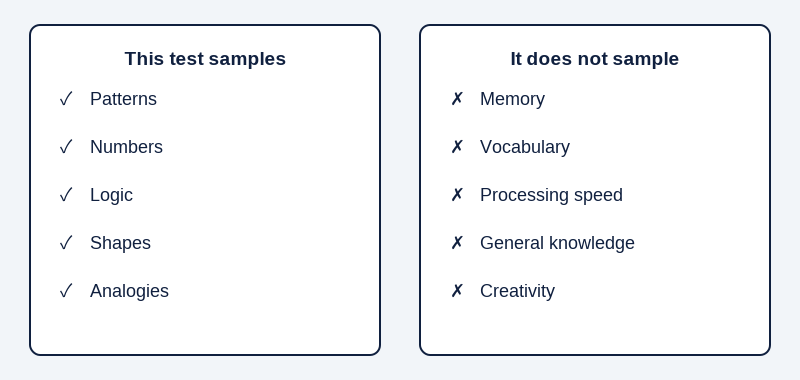
Memory. This test does not include a dedicated working memory or recall battery. Remembering instructions for a single puzzle is not the same as a measured memory score.
Processing speed. The test has an overall time limit, but time is not scored as a separate ability. A professional battery can measure how quickly and accurately someone completes simple tasks under timed conditions. This test does not report that.
Vocabulary and verbal knowledge. There are no vocabulary definitions or general verbal comprehension subtests. Letter based puzzles use letters as symbols or codes, not as a test of word knowledge.
General knowledge. No questions ask for facts about history, science, geography or current events.
Creativity. Every puzzle here has one correct answer that fits the rule. Open ended generation of ideas, where many answers could be good, is a different kind of task and is not sampled.
Emotional and social ability. Reading other people, managing emotions, cooperating, persuading and judging social situations are not measured by shape, number or logic puzzles.
Motivation, persistence and character. A short timed quiz cannot separate ability from how much effort someone chose to give it in an unsupervised setting.
Real world achievement. School results, job performance and practical problem solving depend on knowledge, experience, opportunity, health and sustained effort as well as reasoning. A puzzle score does not predict a life outcome on its own.
If a decision depends on one of these areas, a reasoning puzzle score is the wrong instrument for it, no matter how carefully the puzzles were built.
Why a short quiz cannot assess every cognitive ability
Breadth takes time. A professional assessment can spend over an hour building separate scores for different abilities, with many items for each. A 10 or 30 minute online test has to choose. This site chose reasoning tasks that can be generated, checked automatically for a single correct answer, and completed in a browser without special equipment or an administrator in the room.
Length also limits precision. With 15 puzzles, a careless slip or a lucky guess moves the estimate more than it would in a 40 puzzle test, which is why the quick test carries the wider likely range. Adding more abilities without adding more time would make each area thinner and the estimate noisier, not richer.
Administration limits sampling too. Tasks that need spoken responses, physical materials, precise reaction timing or an examiner do not translate honestly to an unsupervised browser test. Leaving them out is more accurate than pretending to measure them badly.
How professional test batteries differ
Professional batteries differ from an online quiz in breadth, administration and scoring evidence.
In breadth, they cover more than reasoning alone. Depending on the battery and the reason for assessment, that can include verbal comprehension, perceptual reasoning, working memory and processing speed as separate areas, each with its own subtests.
In administration, a professional test is given one to one by a trained examiner, in a controlled setting, with standardized instructions and timing, and the examiner records behavior as well as answers.
In scoring, professional scores are standardized on a large, representative norm group, with separate comparisons by age band, and published reliability and validity evidence. This site is explicit that its test has not been standardized in that way and that no reliability or validity figures exist for it yet.
High IQ societies draw the same line in practice. American Mensa and Mensa International describe membership as requiring a score in the top 2 percent on an approved, supervised test, and online test scores are not accepted for that purpose. An online result can be interesting, and it can be a reason to consider formal testing. It is not a substitute for it.
A worked example: reading a result sensibly
Suppose two visitors both receive an estimate of 115 on the full test.
| Reader | Estimate | Likely range shown | Area breakdown | Sensible reading |
|---|---|---|---|---|
| Visitor A | 115 | 107 to 123 | Strong on Patterns and Numbers, weaker on Shapes | Above average reasoning performance on this test, with a clear spatial area to practice interpreting cautiously |
| Visitor B | 115 | 107 to 123 | Even across all five areas | The same headline estimate, with a flatter profile and the same wide range around it |
The worked example shows the limit of the headline number. Both visitors share an estimate and a range. The useful extra information is the breakdown and the range, not a claim that 115 describes their intelligence as a whole, predicts their career, or would be reproduced exactly by a professional battery. If either visitor retook the test on a tired evening with interruptions, a result inside that same range would be unremarkable.
Sources and limitations
Sources consulted for the factual claims in this article are limited to the verified source bank for this project. The statement about Mensa reflects American Mensa (us.mensa.org/learn/about/) and Mensa International (mensa.org): membership requires a score in the top 2 percent on an approved, supervised test, and online tests are not accepted. Scale statements reflect the site methodology: average 100, standard deviation 15, estimates clamped between 55 and 145, and a percentile derived from the normal curve rather than counted from a norm group.
Limitations of this article match the limitations of the test. This site's test is unsupervised, covers reasoning only, has not been standardized on a representative sample, and has no reliability or validity figures. Nothing in this article changes that. Do not use an online result for medical, educational or employment decisions.
Frequently asked questions
Does an online IQ test measure your intelligence?
It measures performance on the specific reasoning tasks it contains. Intelligence is a broader concept than any short task sample, so treat the score as a narrow performance estimate, not a complete measure of intelligence.
Can an online test measure memory or processing speed?
Some longer assessments are designed to sample those areas with dedicated subtests. This test does not. It reports reasoning across five puzzle areas only, and time is used as an overall limit rather than as a separate speed score.
Why does my breakdown matter if I only want the overall score?
Because the same overall estimate can come from very different profiles. The breakdown shows which task types drove the result on this attempt, which is often more useful and less misleading than the headline number alone.
If the test does not measure everything, is it pointless?
No. A narrow measure can still be informative if you read it narrowly. It can show how you approached these puzzle types today and give a rough band for that performance. It becomes misleading only when it is read as a verdict on abilities it never sampled.
Sources
Mensa International, Getting your IQ tested (FAQ). Membership needs a score in the upper 2 percent on an approved, supervised test; online tests cannot be used for admission. Accessed 7 November 2026.
Pearson Assessments, Wechsler Adult Intelligence Scale, Fourth Edition (WAIS-IV). Ten subtests across four domains, verbal comprehension, perceptual reasoning, working memory and processing speed, taking 60 to 90 minutes. Accessed 7 November 2026.
OpenStax Psychology, 7.5 Measures of Intelligence (Rice University). IQ tests must be given by a licensed psychologist; the scale has a mean of 100 and a standard deviation of 15. Accessed 7 November 2026.
American Psychological Association, Testing, assessment, and measurement. Psychological tests are standardized instruments used to measure behaviour or mental attributes, including intelligence and cognitive abilities. Accessed 7 November 2026.
Try the test
Take the free test, 15 puzzles in 10 minutes or 40 puzzles in 30 minutes, and see your estimate, your likely range and a breakdown across Patterns, Numbers, Logic, Shapes and Analogies, with every answer explained.